

Cash, Promotional Credit, and Withdrawable Funds: Three Balances That Can Differ
Introduction
A balance on screen may look like a simple measure of what an account holder owns. In practice, it can combine deposited money, promotional credit with specific conditions, and funds currently available for withdrawal.
These categories may overlap, but they are not interchangeable. The distinction matters in any digital account where money can be added, used, credited after a transaction, or held until a condition is met. The total may show how much value is available inside the account without showing how much can be withdrawn.
Platforms set their own labels and rules, so there is no universal accounting model. Treat each balance as a separate line in a ledger: ask where it came from, how it can be used, and what must happen before it can be withdrawn.
Analysis of the balances
Cash usually means money deposited into an account or credited as ordinary funds. It may be available for permitted transactions, but that does not necessarily mean it can be withdrawn immediately. A payment may still be processing, require verification, or be restricted by the method used to add it.
This distinction is easy to miss. A deposit may appear in the account while the payment process is incomplete, or some cash may be reserved for a transaction that has not settled. In either case, the displayed balance may differ from the amount available for another transaction.
Promotional credit is usually granted under specific conditions rather than deposited as unrestricted cash. Its terms may limit how or when it can be used, how long it remains valid, and whether it can be withdrawn. Some offers convert qualifying activity or returns into cash; others allow the credit to be used for transactions but remove it if a condition is not met or the offer expires.
The label alone does not explain the rules. Promotional credit may appear alongside cash, in a separate wallet, or as a balance that applies only to certain transactions. Check the terms to see what counts as qualifying use, how any resulting funds are calculated, and whether the original credit can be withdrawn.
Withdrawable funds are the amount an account holder can currently request to transfer out, subject to the platform’s procedures. This may be less than the cash balance if funds are pending, reserved, or awaiting checks. Promotional credit may also be excluded, even if it is visible and usable in the account.
Withdrawable funds are not simply another name for the account total. They show what can be paid out now, not all the value displayed on screen. A withdrawal may still take time to process, so eligibility and arrival in an external account are separate stages.
Key factors
The first factor is source. Deposits, promotional awards, refunds, and returns from earlier transactions may be recorded differently. Knowing where a figure came from is often more useful than knowing which screen displays it.
The second is status. Pending, cleared, reserved, and available describe different stages in the movement of funds. A cleared amount may still require a withdrawal review, while reserved funds may be included in the total but unavailable for other uses.
Next, consider the conditions attached to credit. These may include a deadline, a qualifying-activity requirement, a minimum threshold, or limits on eligible uses. Offers with the same face value can produce different usable or withdrawable amounts.
Transaction order can also affect the balance. A system may use promotional credit before cash, or the reverse. It may allocate a return proportionally or use another calculation. When multiple sources fund one transaction, the result depends on the allocation rules, not just the headline amount.
Finally, verification and payment processing can affect timing. A platform may require identity checks or confirmation of account ownership before releasing funds. This may not change the balance itself, but it can affect whether the funds are eligible for payout.
To check the figures, reconcile the account like a ledger: starting cash, promotional credit, transactions, returns, fees or adjustments, and the resulting withdrawable amount. If the numbers do not add up, a status, allocation rule, or condition may be missing from the picture.
Match scenario
Consider a hypothetical match-day account with $100 in deposited cash and $50 in promotional credit. The screen might show a total of $150, but that does not mean the full amount can be withdrawn. The cash may be available for use, while the promotional credit remains conditional and excluded from payouts.
Suppose a transaction uses $20 in cash and $10 in promotional credit, then produces a $45 return. Those figures alone do not show whether the entire return is withdrawable cash. The platform’s terms determine how the return is allocated, whether the promotional portion carries restrictions, and whether settlement or verification is still required.
Now suppose a withdrawal is under review. The account may still show the same total, while the amount available to transfer is lower or temporarily unavailable. What matters is how each source and status is recorded after settlement.
A single balance can therefore give an incomplete picture. A breakdown by source and status helps distinguish value that can be used, value subject to conditions, and value that can actually be paid out.
Conclusion
Cash, promotional credit, and withdrawable funds answer different questions. Cash describes a source or category of money; promotional credit is subject to additional terms; withdrawable funds show what can leave the account at that moment.
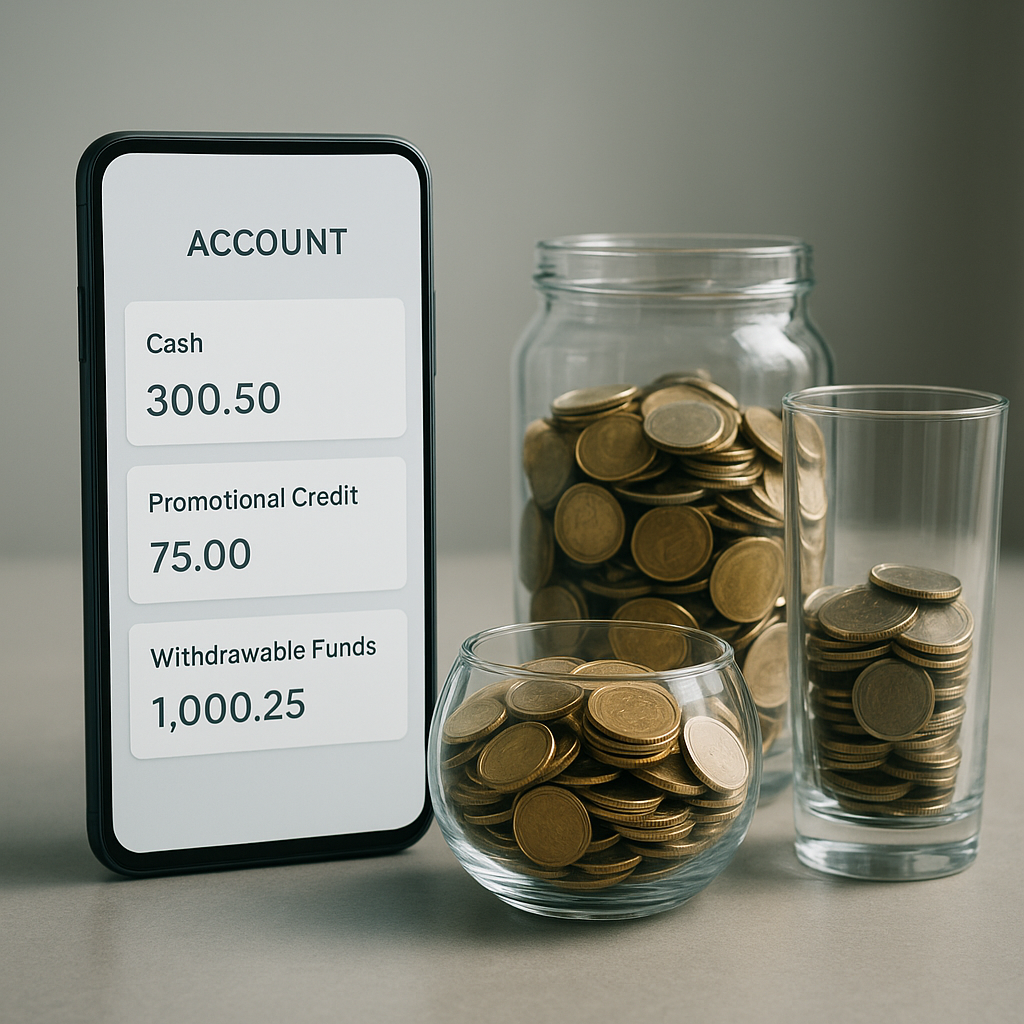
If these figures differ, the gap is not necessarily an error, but it should be explainable. Check the balance labels and relevant terms, see how transactions are allocated, and distinguish payout eligibility from processing time. This is the best way to understand what an account total means in practice.